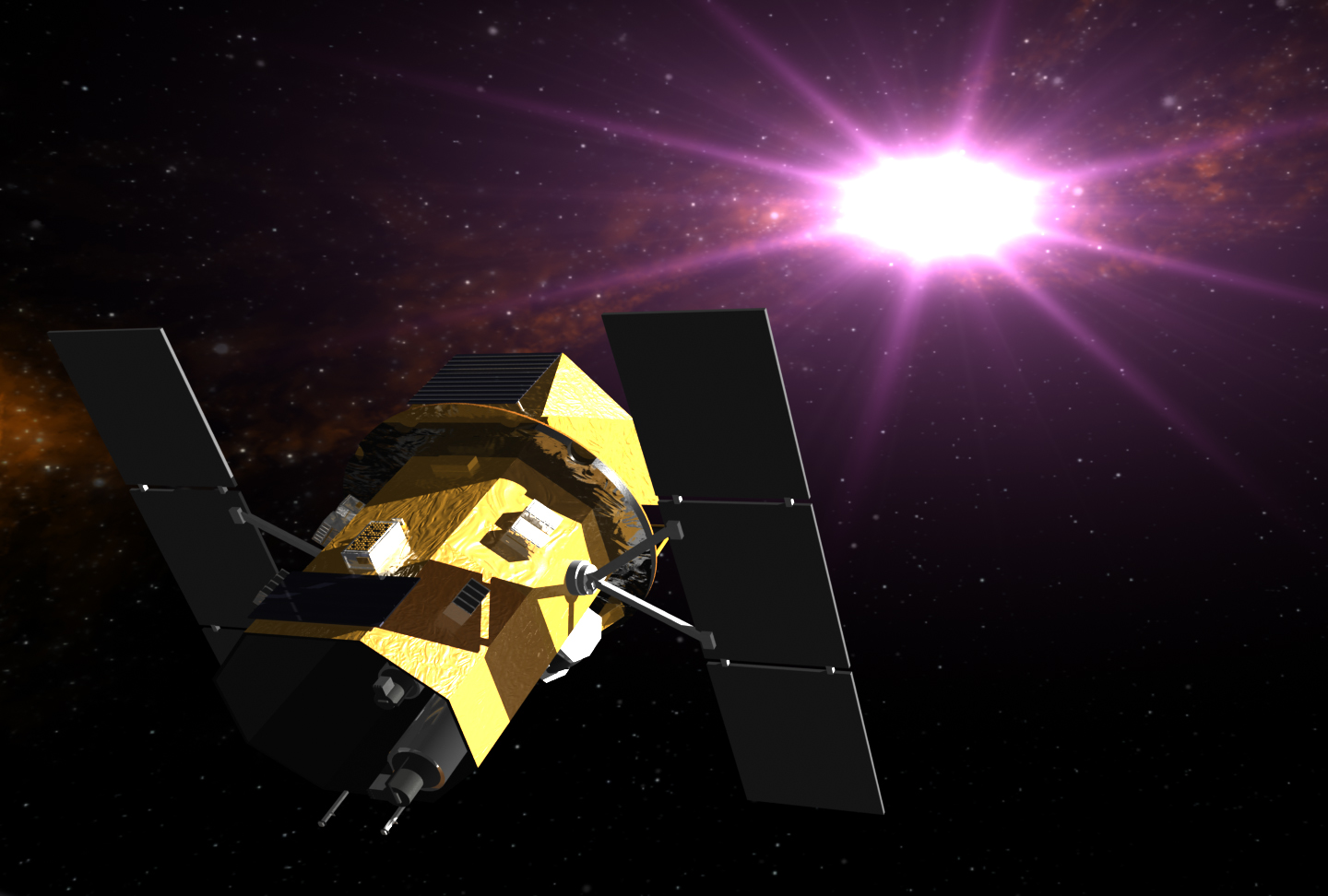
NASA’s Neil Gehrels Swift Observatory has re-entered Earth’s atmosphere, bringing a nearly 22-year mission to an end. NASA confirmed that the spacecraft came down at 7:39 a.m. EST on November 4, 2026, over the North Sumatra region of Indonesia. Most of the observatory was expected to burn up during re-entry, although NASA said some components may have survived. Launched in 2004, Swift studied gamma-ray bursts and other high-energy events, giving scientists a rapid way to investigate some of the universe’s most powerful explosions.
Why Swift mattered

Swift was designed to detect gamma-ray bursts and quickly alert observatories around the world so they could study the event at other wavelengths. These bursts are associated with some of the most energetic explosions known. Because the initial signal can be brief, a fast alert allows ground-based and space-based telescopes to turn toward the same region and collect follow-up observations.
Its ability to turn toward a target rapidly helped researchers investigate explosions that can last only seconds or minutes. The mission also contributed observations of supernovae, galaxies, black holes and other energetic objects. In astronomy, a quick observation can make the difference between capturing the aftermath of an event and missing the most informative period.
Why Swift’s orbit decayed

Like other low-Earth-orbit spacecraft, Swift gradually lost altitude as it encountered the extremely thin upper atmosphere. Increased solar activity heated and expanded that atmosphere, increasing drag and accelerating the observatory’s descent. NASA reported that Swift reached about 171 miles (275 kilometers) on October 20, after which it could no longer compensate for the drag and entered safe mode.
Swift had no propulsion system capable of raising its orbit. NASA had explored a rescue attempt using a robotic spacecraft built by Katalyst Space Technologies, but the LINK vehicle developed control problems after launch and the capture mission was called off in August. Without a successful orbit boost, Swift’s re-entry became unavoidable.
What happened during re-entry?

As Swift entered denser air at orbital speed, aerodynamic heating caused the spacecraft to break apart. NASA expected most of the observatory to burn up, while acknowledging that some denser components could survive. The U.S. Space Force confirmed the re-entry time and location: 7:39 a.m. EST over North Sumatra, Indonesia, at approximately 3.4 degrees north latitude and 98.6 degrees east longitude.
The confirmed re-entry location is not the same as a confirmed impact point for any surviving fragment. NASA’s update says some components may have survived, but the agency expected most of the spacecraft to burn up. The distinction matters: tracking data identifies where the spacecraft entered the atmosphere, not necessarily where every piece ended up.
A mission’s end is not the end of its discoveries

Swift’s scientific legacy will continue through the data it collected and the research built on those observations. Space missions often outlive their original planned operating periods, and archived data can remain useful long after a spacecraft stops transmitting. Researchers can revisit older observations with new tools, compare them with newer missions and ask questions that were not possible when the data was first collected.
The observatory’s final descent is a reminder that space science depends on both dramatic discoveries and long, careful records. A spacecraft may eventually stop operating, but its contribution does not disappear when its orbit ends.
Sources

- NASA: Swift Observatory re-entered the atmosphere, updated November 4, 2026
- NASA: Swift mission ends ahead of re-entry
- NASA Astronomy Picture of the Day: A Farewell to Swift, November 6, 2026
- Spaceflight Now: Swift re-enters over western Indonesia



Leave a Reply