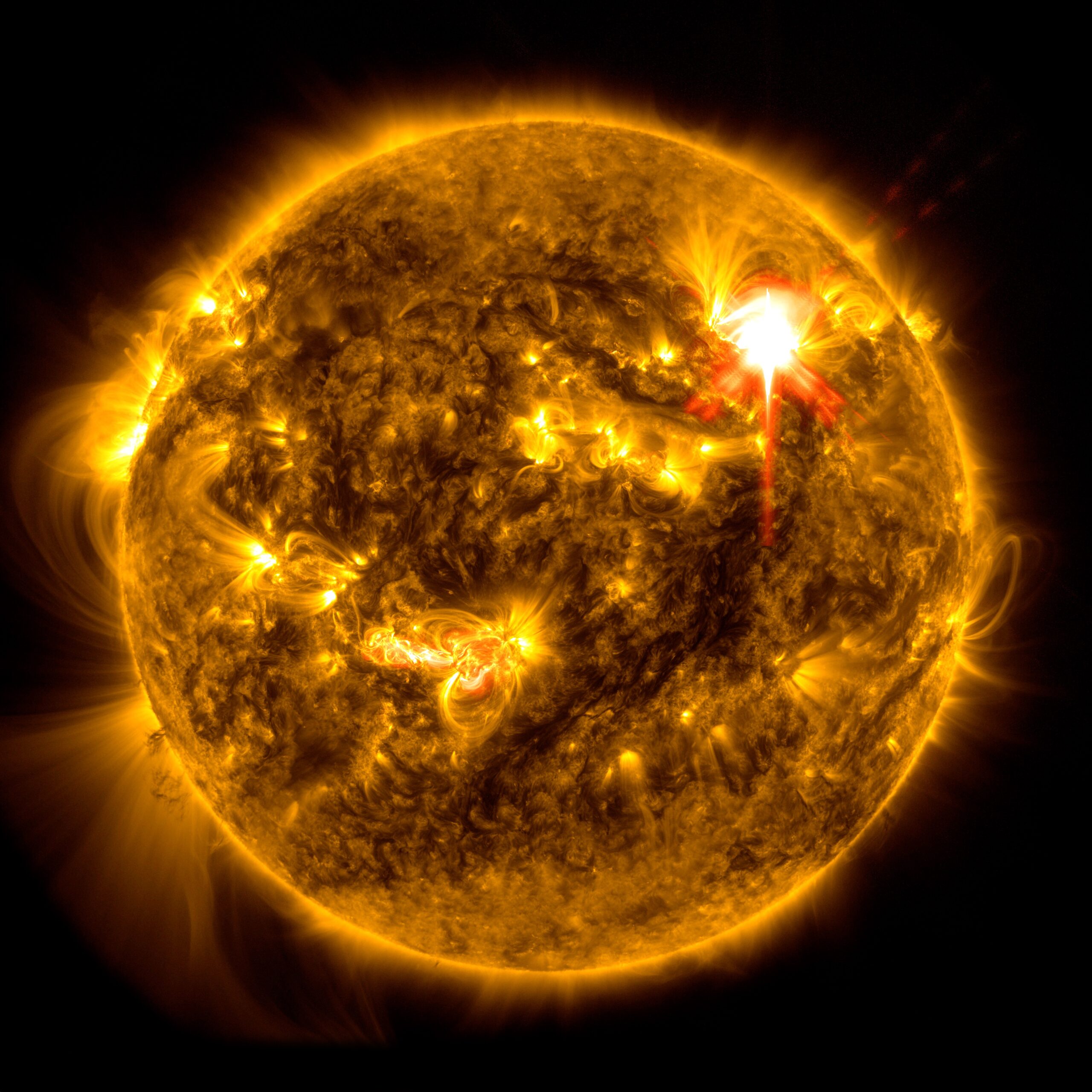
Solar flares are powerful bursts of energy from the Sun, but studying one at exactly the right moment is difficult. A flare can brighten and fade quickly, while a research rocket has to be prepared, launched and pointed toward the right target. Scientists have now demonstrated a system designed to close that timing gap—and NASA says it helped researchers observe solar flares while they were still happening.
In a November 4, 2026 update, NASA described an alert system that identifies a flare’s location and estimates how long it is likely to last. The system helped teams coordinate sounding-rocket launches from Alaska, allowing instruments to collect observations during active flares. The advance is not a new way to stop solar activity. It is a better way to catch important events while they are unfolding.

Why solar flares are difficult to study

A sounding rocket is designed for a short research flight. Unlike a satellite that can remain in orbit for years, a sounding rocket rises above much of Earth’s atmosphere, gathers data and returns. NASA says the relevant observation window for these solar studies can be only about five minutes. That is a very small window when a flare may change rapidly.
The challenge is not simply knowing that the Sun is active. Scientists need to know where the flare is happening and whether it will still be producing useful signals when the rocket reaches the right altitude. If the event fades too soon, the instrument may miss the most important part of the activity.
Traditional alert systems can identify solar activity, but the NASA team wanted more precise information about location and duration. A faster prediction gives launch teams a better chance of matching the rocket’s short flight to the life of the event.
How the new alert system works

According to NASA, the system analyzes X-ray and ultraviolet emissions from active regions on the Sun. These are magnetically complex areas that can produce solar flares. The system uses observations from NASA’s Solar Dynamics Observatory, NOAA’s Geostationary Operational Environmental Satellites and ground-based observatories.
By combining those observations, the system can pinpoint where a flare is occurring and estimate how long it may remain active. That information helps scientists decide whether to launch a sounding rocket. The alert is therefore part of a larger chain: observatories detect activity, software evaluates the event, researchers assess the opportunity and a rocket team acts within a limited window.
NASA reported that the system supported coordinated launches in April 2024 and that an enhanced version was used in May 2026. During the May flight, the FOXSI-5 instrument successfully observed three small solar flares. The research was described in a paper published November 4 in The Astrophysical Journal.
What the rockets are trying to measure

Solar flares release energy across the electromagnetic spectrum and accelerate particles into space. Some of the radiation that scientists want to study is absorbed by Earth’s atmosphere, which is why instruments need to rise above much of that atmosphere. A sounding rocket can provide a relatively fast and less expensive way to make a targeted observation compared with launching a full satellite mission.
The FOXSI instrument family is designed to study high-energy X-rays from the Sun. Those observations can help researchers understand how energy is released and how particles are accelerated in the solar atmosphere. The more accurately scientists can time a flight, the better their chance of collecting data during a flare that might otherwise disappear before the instrument is ready.
Why space weather matters on Earth

Solar flares are part of space weather, a broad term for changing conditions in space driven by the Sun. Strong solar activity can affect radio communications, navigation systems, satellites and electrical infrastructure. The impact depends on the type of event, its intensity, direction and interaction with Earth’s magnetic environment.
A solar flare is not the same thing as a geomagnetic storm, and not every flare causes a major disruption on Earth. Some events produce strong radiation that matters for spacecraft and high-altitude operations, while other solar eruptions can send charged particles and magnetic fields toward Earth. The details matter, which is why researchers study different parts of the process.
Better observations can improve scientific models and help researchers understand how solar activity develops. That knowledge supports space-weather monitoring and helps operators make informed decisions about satellites, communications and other systems that can be affected by the Sun.
What this breakthrough does—and does not—mean

The alert system is a research tool, not a universal warning system that predicts every dangerous solar event. It was designed to help a particular kind of scientific mission catch short-lived flares. It does not guarantee that every flare can be forecast accurately or that all space-weather impacts can be prevented.
It is also not a replacement for NOAA’s operational space-weather monitoring. Instead, it shows how faster coordination between observations and mission teams can make research flights more effective. The same general principle—turning a detection into a timely decision—could help future rocket campaigns and solar observatories.
Why five minutes can be scientifically valuable

A short observation can still be powerful when it captures the right event. A well-timed measurement can test a model, reveal a feature that is difficult to observe from the ground or help scientists compare what different instruments see at the same moment.
The system also demonstrates the value of combining data sources. A single observatory may provide an incomplete picture. X-ray and ultraviolet observations, satellite data and ground-based measurements can offer complementary information. When the system can process those signals quickly, scientists can use the combined picture to make a better launch decision.
What researchers will work on next

NASA says the team continues to improve the alert system through support from its Early Career Investigator Program. Future work could refine how the system estimates flare duration, improve the speed of its alerts and support additional rocket or observatory campaigns.
The larger scientific question remains how solar flares release energy and accelerate particles. Each successful observation adds another piece of evidence. Better timing does not answer every question, but it makes it more likely that researchers will collect useful data when the Sun provides a brief opportunity.
The bottom line

NASA’s solar-flare alert system is a practical improvement in scientific timing. By identifying where a flare is occurring and estimating how long it may last, it gives rocket teams a better chance of launching while the event is still active. The FOXSI-5 mission’s observations show how that coordination can turn a narrow five-minute window into valuable research.
For the public, the significance is not that the Sun has become predictable. It is that scientists are improving the tools used to study it. As society depends more heavily on satellites, navigation and communications, a deeper understanding of solar activity is useful—not because every flare is dangerous, but because better measurements lead to better knowledge of the environment around Earth.
Sources and further reading

NASA Science: Solar Flare Alert System Helps NASA Rocket Team Decide When to Launch (Nov. 4, 2026).
NASA Science: Latest Science News.
Related reading: NASA’s Aging Swift Telescope Faces a Fiery Return After 22 Years in Orbit.




Leave a Reply