Some places are frightening because of what people say happened there. Others are frightening because of what we know happened. Across the world, abandoned islands, underground chambers, silent forests and landscapes shaped by disaster have gathered reputations that are difficult to forget. Some are tied to documented tragedies; others are wrapped in folklore, ghost stories or internet myths that grew far beyond the evidence.
This list brings together 15 of the scariest locations on Earth—not as a claim that ghosts have been proven to exist, but because each place has a history, setting or legend that can make even the bravest traveler pause. We separate the documented past from the stories people tell, because the truth is often more fascinating than the exaggeration.
15 of the scariest places in the world
Quick note: Several locations below are restricted, fragile, dangerous or culturally sensitive. This is a history and travel feature, not an invitation to trespass, enter unsafe structures or disturb protected sites.
1. The Island of the Dolls, Mexico

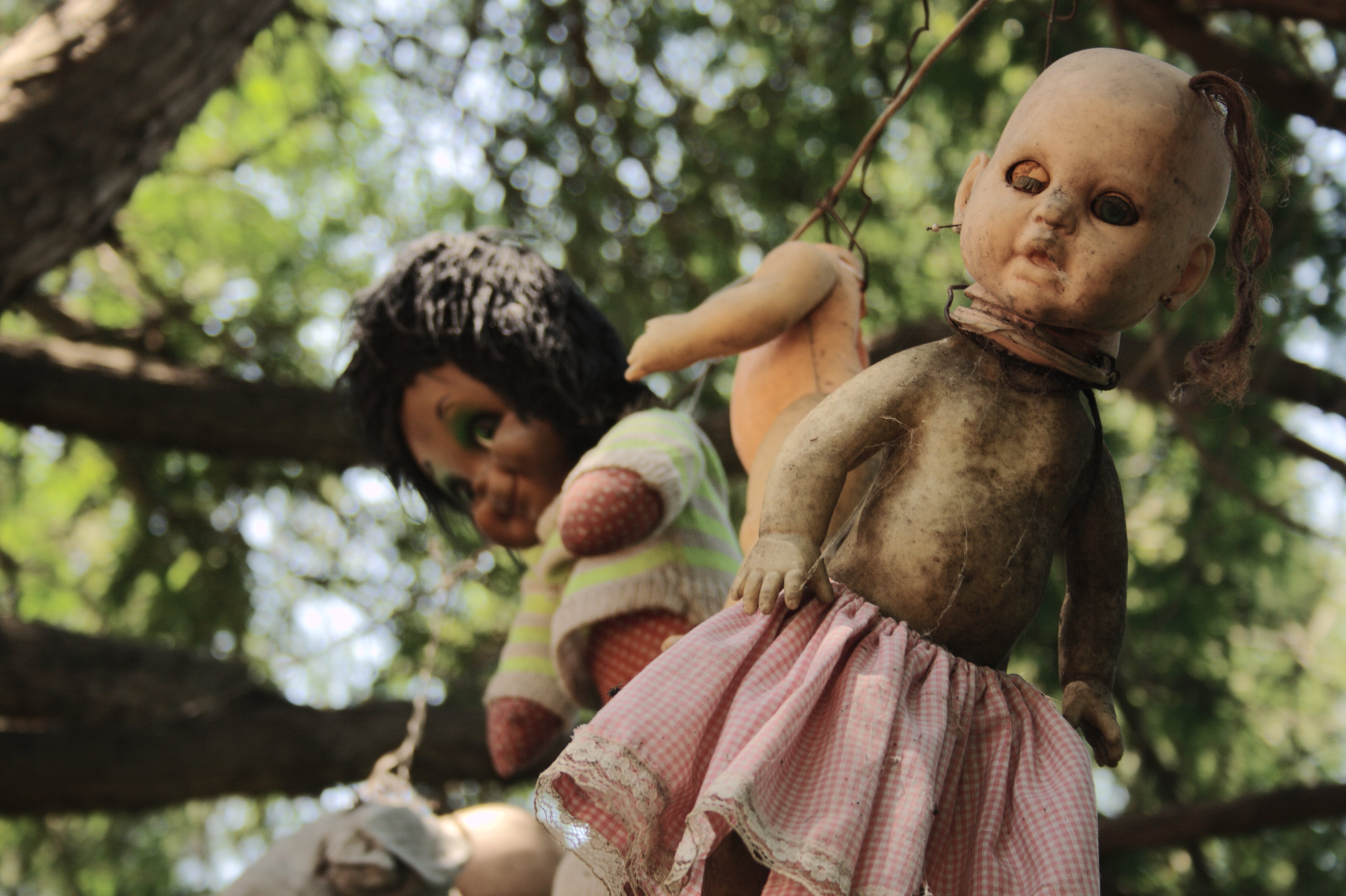
Deep inside the canals of Xochimilco, south of Mexico City, a small artificial island is covered with old dolls: cracked faces, missing limbs, faded dresses and plastic eyes staring through the branches. The effect is unsettling even in daylight. The island is known as Isla de las Muñecas, or the Island of the Dolls, and its strange appearance grew from the personal obsession of a man named Julián Santana Barrera. Guinness World Records recounts the local legend that Santana believed a young girl had drowned in the nearby canal and began hanging dolls as offerings to the spirit he thought remained there. He continued collecting dolls for years, turning the chinampa into an eerie outdoor shrine. The drowning story is folklore, not a verified supernatural event, and the dolls themselves are not proof of a haunting. What is real is the extraordinary collection and the unsettling atmosphere it creates among the quiet waterways.
2. Poveglia Island, Italy

A short distance from Venice, Poveglia sits in the Venetian Lagoon with abandoned buildings and a ruined bell tower visible across the water. Its documented past is already grim: it served as a quarantine station and maritime health facility, and its buildings were used as a sanatorium for elderly long-term patients from 1922 until the hospital closed in 1968. Its most lurid stories—mass burials, cruel doctors and paranormal events—are not established historical facts. Research into the island’s reputation traces much of its modern haunted-island mythology to paranormal media and websites in the 2000s. That distinction matters: Poveglia’s documented history of isolation and institutional care is already sobering without inventing a horror story. Access is restricted, and visitors should not attempt to land without explicit permission. The view from the lagoon is eerie enough without trespassing.
3. The Paris Catacombs, France

Beneath the streets of Paris is a vast network of former limestone quarries, part of which became an underground ossuary holding the remains of millions of people. In the late eighteenth century, overcrowded cemeteries and public-health concerns led city authorities to transfer bones underground. The first major transfers took place between 1785 and 1787, and the site was consecrated as the Paris Municipal Ossuary in 1786. The official Catacombs history explains how the bones were later arranged in the galleries, creating the skull-and-bone walls that visitors see today. The darkness, narrow passages and human remains make the place feel like a horror-film set, but its origins are practical and historical rather than supernatural. The public route is only a small portion of the underground network; wandering into closed tunnels is dangerous and prohibited.
4. The Capuchin Catacombs of Palermo, Italy

In Palermo, Sicily, the Capuchin Catacombs preserve a remarkable and deeply unsettling record of how some communities once treated death. The underground cemetery began with the burial of a friar in 1599. Over subsequent centuries, thousands of people—including clergy, professionals and members of wealthy families—were preserved and displayed in their clothing. The corridors are arranged by categories, and some bodies remain upright in niches, creating the impression of a silent crowd frozen in time. The site is not simply a horror attraction: it reflects historic beliefs about remembrance, status, mourning and the desire to remain visible to family after death. Palermo’s tourism guide estimates that roughly 8,000 mummified bodies are preserved in the complex; the figure is an estimate rather than a complete inventory. Among its best-known residents is Rosalia Lombardo, a child whose remarkably preserved remains became famous. The atmosphere is powerful because the people displayed there were real individuals, not props.
5. Pripyat, Ukraine

Pripyat was built in the Soviet Union to house workers and families connected to the nearby Chernobyl Nuclear Power Plant. It was a young, modern city with schools, shops, apartments and an amusement park. That life changed after the reactor disaster on April 26, 1986. The city was evacuated roughly 36 hours after the accident, leaving homes and public spaces behind. History reports that about 49,000 residents were evacuated. Today, the empty apartment blocks and decaying amusement park have become some of the most recognizable images of an abandoned city. Pripyat is frightening not because it is proven to be haunted, but because its emptiness is tied to a real technological catastrophe and the sudden displacement of an entire community. The Chernobyl Exclusion Zone remains controlled; do not attempt unauthorized entry.
6. Aokigahara Forest, Japan

At the base of Mount Fuji, Aokigahara is a dense forest that grew over volcanic rock from an ancient eruption. The Japan National Tourism Organization describes a woodland of roughly 30 square kilometres, where the porous lava ground absorbs sound and can make the forest feel unusually quiet. Japanese folklore associates the area with yūrei, or restless spirits, and the forest’s reputation has been amplified by books, films and sensational media coverage. It is important to separate that folklore from the real place: Aokigahara is also a natural habitat, a hiking destination and part of the landscape around Mount Fuji. Its association with suicide has caused real pain to families and communities, so the subject should never be treated as a thrill-seeking attraction or romanticized. Visitors should stay on marked paths, respect local guidance and approach the forest with care. The official Japan travel guide provides natural-history and visitor information.
7. Hoia-Baciu Forest, Romania

On the edge of Cluj-Napoca in Transylvania, Hoia-Baciu Forest has earned the nickname “the Bermuda Triangle of Transylvania.” Visitors and local storytellers have described strange lights, unusual sensations, unexplained photographs and stories of people becoming lost. A circular clearing, often called the Round Meadow, has become one of the forest’s most recognizable features. These accounts are part of the area’s modern folklore; they are not scientific proof of portals, UFOs or paranormal activity. The woodland itself is real and atmospheric, with winding paths and trees that can look unusually contorted. The Guardian’s report on Hoia-Baciu explores how the stories and guided night walks have shaped its reputation. The most unnerving part may be how easily an ordinary forest can feel unfamiliar after dark.
8. Bhangarh Fort, India

Bhangarh Fort stands among the Aravalli hills in Rajasthan, surrounded by the remains of temples, markets, houses and a royal palace. It was once a prosperous settlement, but the town declined and was eventually abandoned. Its reputation as one of India’s most haunted places comes from competing legends. One says an ascetic warned that no building should cast a shadow over his retreat; another tells of a sorcerer who cursed the town after his pursuit of Princess Ratnavati failed. Rajasthan Tourism presents these stories as local legends, while also documenting the fort’s architecture and history. The ruins are compelling even without the supernatural claims: visitors can see the layout of a once-living town slowly reclaimed by time. Official visitor information lists daytime access, generally 9 a.m. to 5 p.m.; the site is closed to visitors before sunrise and after sunset. Follow current instructions from Rajasthan Tourism and do not attempt to enter after closing.
9. Centralia, Pennsylvania, USA

Centralia looks like a ghost town because, in many ways, it became one. An underground coal-mine fire began in May 1962 and continued spreading through abandoned mine workings beneath the borough. Attempts to control it were unsuccessful, and concerns about toxic gases, ground instability and subsidence led to property acquisitions and relocation. The Pennsylvania Department of Environmental Protection warns that the affected area is extremely dangerous and specifically discourages people from visiting the immediate fire zone. This is not a haunted-town story: it is a long-running environmental and public-safety disaster. The idea of a fire burning beneath a town for decades is unsettling enough, especially when paired with the abandoned roads and empty lots that remain. For the real timeline, see the state’s Centralia Mine Fire chronology.
10. The Darvaza Gas Crater, Turkmenistan

In the Karakum Desert, a huge crater glows with flames that have burned for decades. Known as the Darvaza Gas Crater or the “Door to Hell,” it is a methane-emitting pit that became a surreal landmark in the desert. The popular account attributes the collapse to Soviet gas exploration, but the precise timeline has long been disputed. NASA described the familiar 1971 drilling-accident story, while a 2026 peer-reviewed satellite study found that the crater existed by October 1972 and that sustained flaring began between late 1987 and early 1988. The study notes that the formation date may have been 1963 or 1971, so the familiar story that it was lit immediately after a 1971 accident is not established. That uncertainty makes the location more intriguing, not less: a real, blazing geological-industrial phenomenon wrapped in a story whose details remain unsettled. It is a hazardous site, not a place to approach the flames or descend into the crater.
11. Ilha da Queimada Grande (Snake Island), Brazil

Off the coast of São Paulo state, Ilha da Queimada Grande is home to the golden lancehead, a critically endangered pit viper found naturally nowhere else. The island’s isolation allowed this snake population to evolve in a unique environment, and the species has become the subject of dramatic headlines and exaggerated online claims. A 2026 scientific study in Anais da Academia Brasileira de Ciências specifically examined misinformation about the island and the golden lancehead, warning that sensational stories can harm conservation. Access is controlled for conservation and research purposes; it is not a public adventure destination. The island is frightening to imagine because of its ecology, but its snakes are also a rare part of Brazil’s biodiversity. For the science, consult the peer-reviewed research on Snake Island misinformation.
12. Lake Natron, Tanzania

Lake Natron in northern Tanzania can look otherworldly: a shallow, highly alkaline lake surrounded by volcanic terrain and Rift Valley escarpments. Its harsh chemistry can be dangerous to many animals, and mineral deposits can create striking colors along the shore. That has helped fuel the viral claim that the lake turns animals into stone. The reality is less supernatural and more interesting: the lake is an important ecological habitat, especially for lesser flamingos. The Ramsar Convention identifies the Lake Natron Basin as a major breeding area for lesser flamingos in East Africa. The landscape is both beautiful and unforgiving, which is why it belongs on a list of eerie places—but it should not be reduced to a fake petrification myth. See the Ramsar site information for its ecological importance.
13. The Edinburgh Vaults, Scotland

Beneath Edinburgh’s Old Town are chambers built into the arches of South Bridge. Constructed from the 1780s, the vaults were originally used for storage, workshops and business activity. Damp conditions and water intrusion made many spaces unsuitable, and some later became overcrowded and poor living quarters, taverns and places associated with crime. The City of Edinburgh’s structural report describes the vaults’ construction and changing uses; the city’s tourism guide explains how their history helped create a reputation for ghost stories and paranormal encounters. The setting is naturally unsettling: low ceilings, rough stone, narrow passages and a city moving above your head. Stories of spirits are part of the visitor experience, but the documented history of poverty and difficult living conditions is sobering enough. Explore only with a legitimate guided tour and respect access restrictions.
14. Sedlec Ossuary, Czechia

The Sedlec Ossuary, often called the Bone Church, is a small chapel near Kutná Hora whose interior is decorated with human skeletal remains. The cemetery became an important burial place during the Middle Ages, and as the grounds filled, bones were exhumed and stored in the lower chapel. In the nineteenth century, woodcarver František Rint arranged bones into elaborate decorations, including a chandelier and the Schwarzenberg family coat of arms. The official Sedlec history explains that the remains came from people buried in the cemetery and that the chapel’s message is connected to memento mori—remember that life is temporary. The result is visually shocking, but it is also a religious and historical space. Visitors should treat the remains with respect rather than behaving as if the chapel were a haunted-house attraction.
15. Hashima Island, Japan

Seen from the sea, Hashima Island resembles a battleship made of concrete. Also known as Gunkanjima, it grew into a densely populated coal-mining community after industrial development began in the late nineteenth century. At its peak, thousands of people lived on the tiny island, surrounded by apartment blocks, schools and industrial buildings. When the coal mine closed, the residents left and the island was abandoned in 1974. The Japan National Tourism Organization describes its industrial history and its inclusion in the UNESCO-listed Sites of Japan’s Meiji Industrial Revolution. The buildings have deteriorated, and access is possible only through authorized tour operators when conditions allow. Hashima’s eerie appearance comes from a real community frozen in the landscape—not from a ghost story. Its empty concrete skyline is a reminder of how quickly an industrial world can disappear.
What makes a place genuinely scary?
Fear is not always about ghosts. A place can feel frightening because it preserves evidence of a disaster, because its architecture creates isolation, because nature behaves in an unfamiliar way, or because a community has passed down stories about what happened there. The strongest locations on this list combine more than one of those elements. Pripyat and Centralia carry the weight of real disasters. The Paris and Palermo catacombs confront visitors with the physical reality of death. Hoia-Baciu and Bhangarh show how folklore can become part of a location’s identity.
Are these places actually haunted?
There is no reliable scientific evidence establishing that any location on this list is haunted. Reports of apparitions, curses, unexplained sounds and strange lights belong to local tradition, personal testimony or popular culture unless independently verified. That does not make the stories meaningless: folklore can reveal what communities fear, remember and choose to preserve. But it is important to distinguish a legend from a documented historical event.
Can you visit the scariest places on this list?
Some are established visitor attractions with official routes or guided tours, including the Paris Catacombs, Sedlec Ossuary and parts of the Edinburgh Vaults. Others have strict limits. Poveglia is not an ordinary public attraction; Pripyat is within a controlled exclusion zone; Snake Island is protected and access is restricted; Centralia’s mine-fire area is dangerous; and Hashima can only be visited through authorized tours when conditions permit. Always check current official guidance before planning travel, and never enter abandoned buildings or protected sites without permission.
The bottom line
The scariest places in the world are not necessarily the ones with the loudest ghost stories. Sometimes the most chilling thing is a town emptied overnight, a forest shaped by ancient lava, a chamber filled with the remains of people who lived centuries ago, or an island where nature has taken over the structures people left behind. Their legends may keep visitors curious, but their real histories are what make these places worth understanding.
Sources and further reading
- Guinness World Records — The Island of the Dolls
- IOPAR — Poveglia’s documented history and the origins of its modern haunting legend
- Capuchin Catacombs — Official history
- Rajasthan Tourism — Bhangarh Fort history and legends
- Geophysical Research Letters (2026) — Satellite assessment of Darvaza crater formation and methane emissions
- Paris Catacombs — Official history
- History — Pripyat and famous ghost towns
- Japan National Tourism Organization — Aokigahara Forest
- The Guardian — Hoia-Baciu Forest
- Pennsylvania Department of Environmental Protection — Centralia Mine Fire chronology
- NASA — The Darvaza “Gates of Hell”
- National Geographic — Darvaza Gas Crater expedition
- Anais da Academia Brasileira de Ciências — Snake Island misinformation study
- Ramsar Convention — Lake Natron Basin
- Forever Edinburgh — Underground Vaults
- Sedlec — Official ossuary history
- Japan National Tourism Organization — Hashima Battleship Island
- Palermo tourism — Capuchin Catacombs
Image credits: Each photograph is credited beneath the image with a link to its Wikimedia Commons file record and the applicable Creative Commons or public-domain terms. No image edits were made beyond WordPress-generated display-size variants.



Leave a Reply
You must be logged in to post a comment.