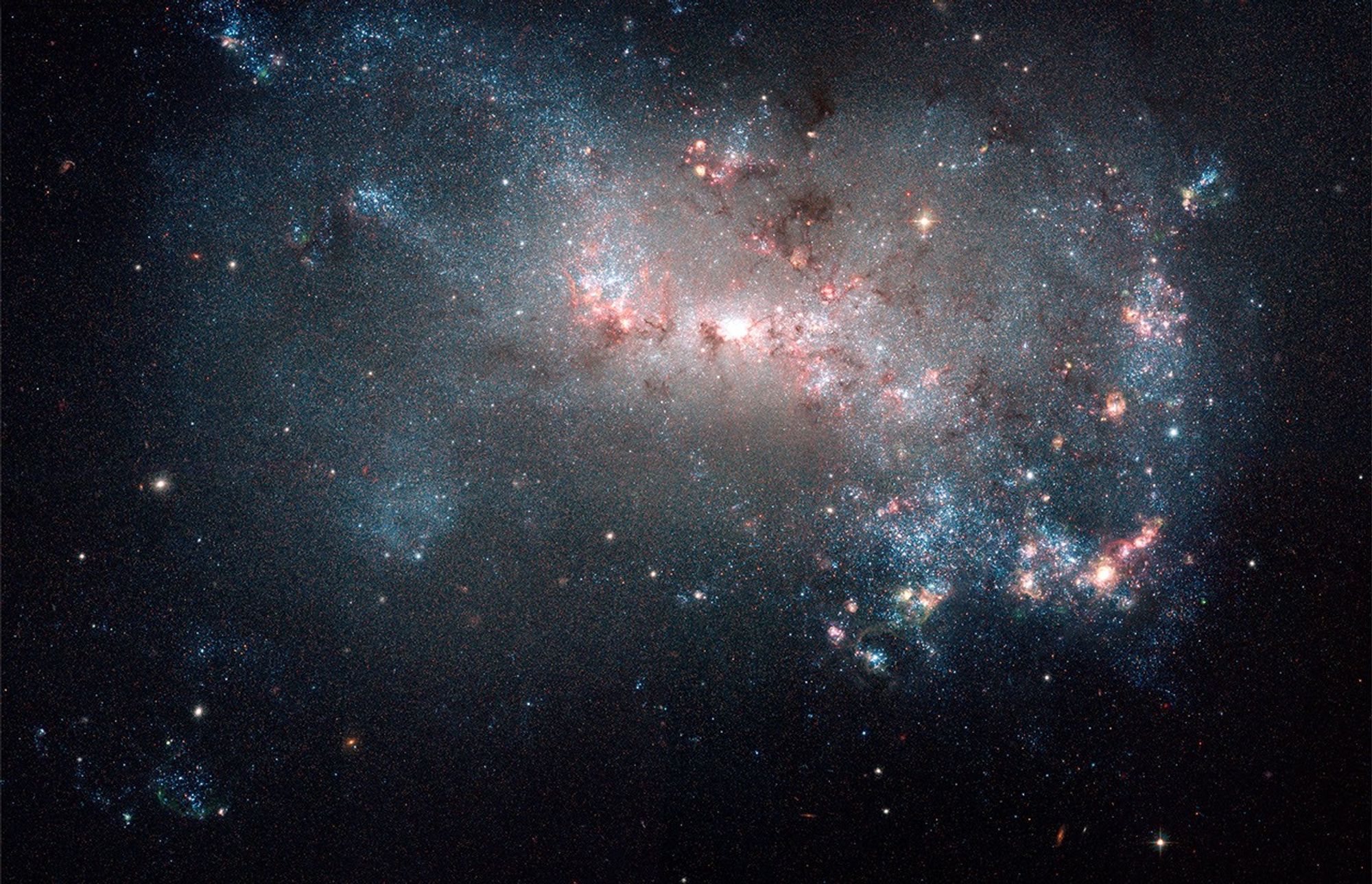
Astronomers using NASA’s Hubble Space Telescope have uncovered a surprising gap in the chemical makeup of nearby dwarf galaxies: many appear to hold far less oxygen than scientists expected. The study examined 37 small galaxies and found that only a fraction of the oxygen produced by their stars remains inside them, challenging models of how galaxies distribute the elements they create.
The finding does not mean oxygen has vanished from the universe. The question is where the material went after stars produced it. Researchers say powerful winds driven by massive stars and supernova explosions may be pushing oxygen out of low-mass galaxies more effectively than current simulations predict.
What Hubble found in the 37 dwarf galaxies

The research team studied 37 nearby dwarf galaxies through the Galaxies Losing Oxygen via Winds project, known as GLOW. Dwarf galaxies contain far fewer stars than large spiral galaxies such as the Milky Way, but they are valuable laboratories for testing how stars form, evolve and enrich their surroundings. Their relatively low mass makes it easier for energetic processes to push gas out of the galaxy.
Oxygen is useful to astronomers because it is produced by stars and is comparatively straightforward to detect. It is also the most abundant element in the universe after hydrogen and helium. By measuring oxygen, scientists can trace how material is distributed among stars, the gas between stars and the space beyond a galaxy. The Hubble observations found that the oxygen expected from the galaxies’ star-formation histories was not all present where the models predicted.
The researchers combined Hubble archival optical observations with data from NASA’s retired Spitzer Space Telescope and radio observatories including the Very Large Array and the Australia Telescope Compact Array. Hubble’s ability to resolve individual stars in these nearby galaxies helped the team reconstruct their star-formation histories and estimate how much oxygen those stars should have produced.
The result points to a mismatch between observations and simulations. Models predict that more oxygen should remain in the galaxies than the researchers measured. The GLOW team argues that energetic feedback from massive stars and supernovae is likely more effective at driving material outward in these low-mass systems than current models account for.
Where the oxygen may have gone—and why the discovery matters

When massive stars reach the end of their lives, supernova explosions release enormous amounts of energy. Together with the winds produced by massive stars during their lifetimes, those events can push gas away from a galaxy. In a small galaxy, whose gravity is weaker than that of a large spiral, that material may escape more easily. The new measurements suggest that this process could be stronger than many simulations have assumed.
There is still an important unanswered question: how far did the oxygen travel? Some of it may remain in the diffuse gas surrounding a galaxy, often called the circumgalactic medium. Some may have moved farther into the intergalactic environment. The new study shows that the oxygen is not where the models expected it to be, but it does not yet map every atom to its final destination.
That uncertainty is scientifically useful. If dwarf galaxies eject more heavy elements than researchers thought, the finding changes how astronomers model galaxy evolution and the chemical enrichment of the universe. Elements made inside stars eventually become part of the material from which later stars, planets and other structures form. Understanding how those elements move helps explain how galaxies develop over cosmic time.
The team hopes future observations will extend the work to even lower-mass galaxies. NASA’s Nancy Grace Roman Space Telescope may help identify faint systems across a much wider area of sky, while Hubble and the James Webb Space Telescope can provide deeper observations of selected targets. The combination could help researchers determine whether the missing oxygen is mainly in surrounding gas or has been expelled farther away.
Read the original NASA Hubble research release and the Space Telescope Science Institute summary.
Researchers are careful about the distinction between oxygen produced and oxygen retained. Stars create oxygen through nuclear processes and later return material to their surroundings. If a galaxy loses a large share of that material through winds, the oxygen may still exist in gas around the galaxy or farther out. The scientific problem is to measure where it is and how much has moved beyond the regions current instruments can easily observe.
The study is also not a claim that every dwarf galaxy behaves identically. The 37 systems provide a valuable sample, but dwarf galaxies vary in mass, environment and star-formation history. Follow-up observations will help researchers test whether the same process dominates across smaller galaxies and different cosmic environments. The combination of Hubble’s resolved-star observations with future Roman and Webb data could turn the initial oxygen discrepancy into a more complete map of how galaxies exchange matter with their surroundings.
This discovery is part of a wider run of recent NASA research stories. Also read our report on the ISS’s completed solar-array upgrade and our earlier coverage of NASA’s solar-flare alert system.
Bottom line: Hubble’s study suggests that dwarf galaxies lose a much larger share of the oxygen made by their stars than models predicted. The next challenge is tracing where that material goes and updating simulations to reflect the stronger galactic winds.



Leave a Reply