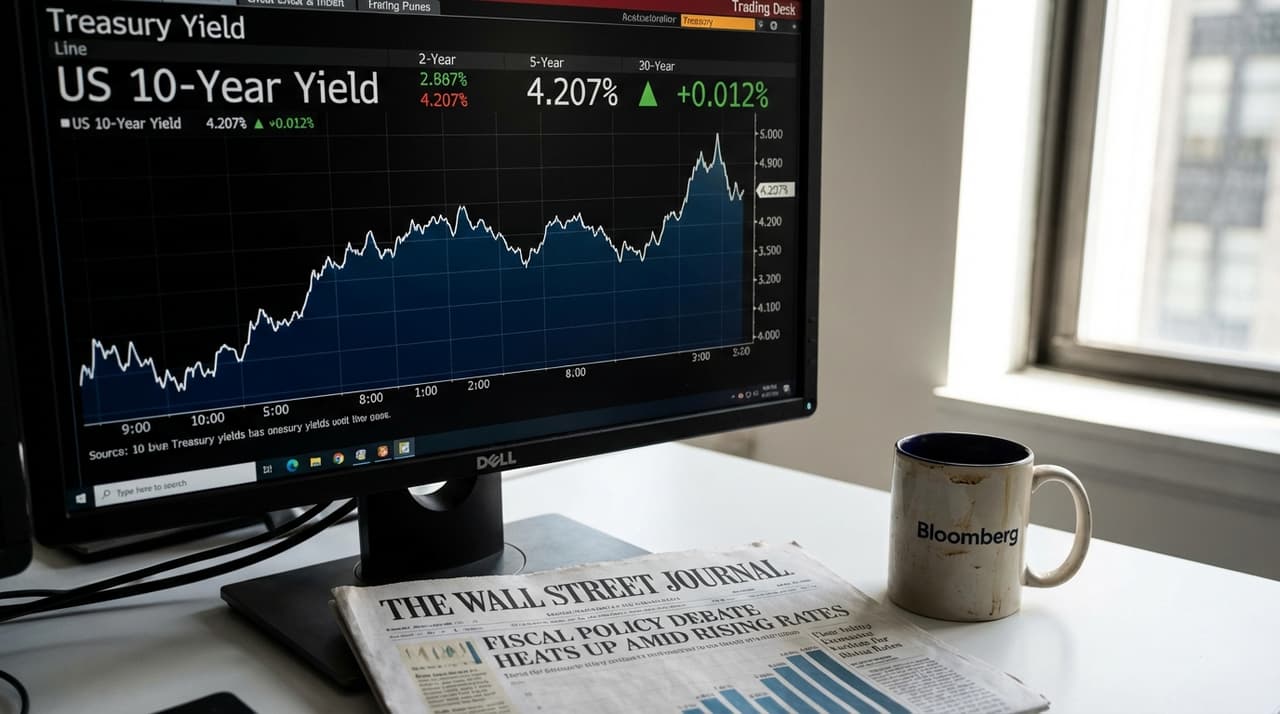
Treasury yields are the returns investors demand for lending money to the U.S. government through Treasury bills, notes and bonds. They are watched by investors, economists, banks and homeowners because they influence borrowing costs across the economy. When a headline says the 10-year Treasury yield is rising, it does not mean the government has changed the interest rate on every bond already in circulation. It means the market is demanding a different return on securities tied to that maturity.
Understanding yields starts with one important distinction: a Treasury security has a stated interest payment or discount structure, but the yield an investor earns depends on the price paid for it and the cash flows received. That is why bond prices and yields generally move in opposite directions.
What is a Treasury yield and how is it calculated?

When you buy a Treasury security, you are lending money to the federal government. Treasury bills are short-term securities sold at a discount and redeemed at face value. Treasury notes and bonds pay interest every six months and return principal at maturity. Notes generally have maturities of two to 10 years, while bonds have longer maturities, including 20 and 30 years.
A yield is the return implied by the security’s price and expected cash flows. A bond’s coupon rate is the interest rate printed on the bond when it is issued. Its current yield compares the annual coupon payments with the market price. Yield to maturity is broader: it estimates the annualized return if the investor holds the security to maturity and receives the scheduled payments, assuming the relevant cash flows occur as expected.
That difference explains why two investors can own the same Treasury bond and have different yields. Someone who bought it at issue may have paid face value, while someone buying it later in the market may pay more or less. The coupon remains the same, but the purchase price changes the return the new buyer earns.
The U.S. Treasury publishes daily par yield curve rates for standard maturities. These constant-maturity rates are interpolated from market quotations and are not the coupon rates on one specific bond. The Treasury explains the methodology and publishes the data in its Daily Treasury Par Yield Curve Rates table.
Why Treasury prices and yields move in opposite directions

Imagine a Treasury note that pays $40 a year in interest on a $1,000 face value. If it trades at $1,000, the coupon payment equals 4% of the price. If investors become willing to pay only $900 for the same future payments, the coupon has not changed, but the annual interest payment is now larger relative to the lower purchase price. Its yield rises.
The reverse happens when demand pushes a bond’s price higher. The fixed coupon becomes smaller relative to the higher price, so the yield falls. This inverse relationship is one of the most important concepts in bond investing. It also means an investor who sells before maturity can receive more or less than the amount originally paid.
Yields can move because investors change their expectations for inflation, economic growth, Federal Reserve policy, government borrowing and the supply of bonds. Demand also matters. In uncertain periods, investors may seek Treasury securities because they are backed by the U.S. government, while stronger expectations for growth or inflation can push required returns higher.
The yield curve compares yields across different maturities. A normally upward-sloping curve often reflects the higher return investors demand for tying up money longer. A flat curve means yields are similar across maturities. An inverted curve occurs when shorter-term yields are higher than longer-term yields. Economists watch these shapes because they can reflect expectations about future interest rates and economic conditions, but the curve is not a reliable calendar for predicting a recession.
For a deeper look at the daily data, the Treasury’s official yield table shows rates by maturity. The Federal Reserve Bank of St. Louis also provides historical Treasury series through FRED’s interest-rate data.
How Treasury yields affect mortgages, savings and investments

The 10-year Treasury yield is often used as a reference point for mortgage rates, but the two are not identical. Mortgage rates also reflect lender funding costs, mortgage-backed security prices, servicing expenses, borrower risk and market spreads. A rise in the 10-year yield can put upward pressure on mortgage rates, but the relationship is not one-for-one and can change.
Shorter-term Treasury yields are influenced more directly by expectations for the Federal Reserve’s policy rate. That can affect the returns available on money-market funds, certificates of deposit and savings products, although banks set their own rates and may adjust them with a delay. Longer-term yields matter for investors evaluating bonds, pension obligations and the cost of financing long-lived projects.
Treasuries can play a role in a diversified portfolio because their payments are backed by the U.S. government, but they are not free of risk. A bond sold before maturity can lose market value when rates rise. Inflation can also reduce the purchasing power of fixed payments. Treasury Inflation-Protected Securities (TIPS) are designed to adjust principal with changes in the Consumer Price Index, although their market prices can still move.
Interest from Treasury securities is generally subject to federal income tax but exempt from state and local income taxes. Tax treatment can differ for other bond types, so investors should review the specific security and their tax situation. TreasuryDirect explains the available securities, purchase process and tax treatment in its marketable securities guide.
For everyday consumers, the key takeaway is that Treasury yields are a benchmark—not a personal borrowing rate or a guaranteed investment return. A higher yield may create better income opportunities for someone buying a new Treasury, while lowering the market value of an older fixed-rate bond. The same movement can influence mortgage rates and other borrowing costs, but those products have their own pricing factors.
Before investing, compare maturity, yield to maturity, price, liquidity, tax treatment and the possibility that you may need to sell early. If the money must be available on a specific date, choose a maturity that matches that need rather than focusing only on the highest headline yield.




Leave a Reply