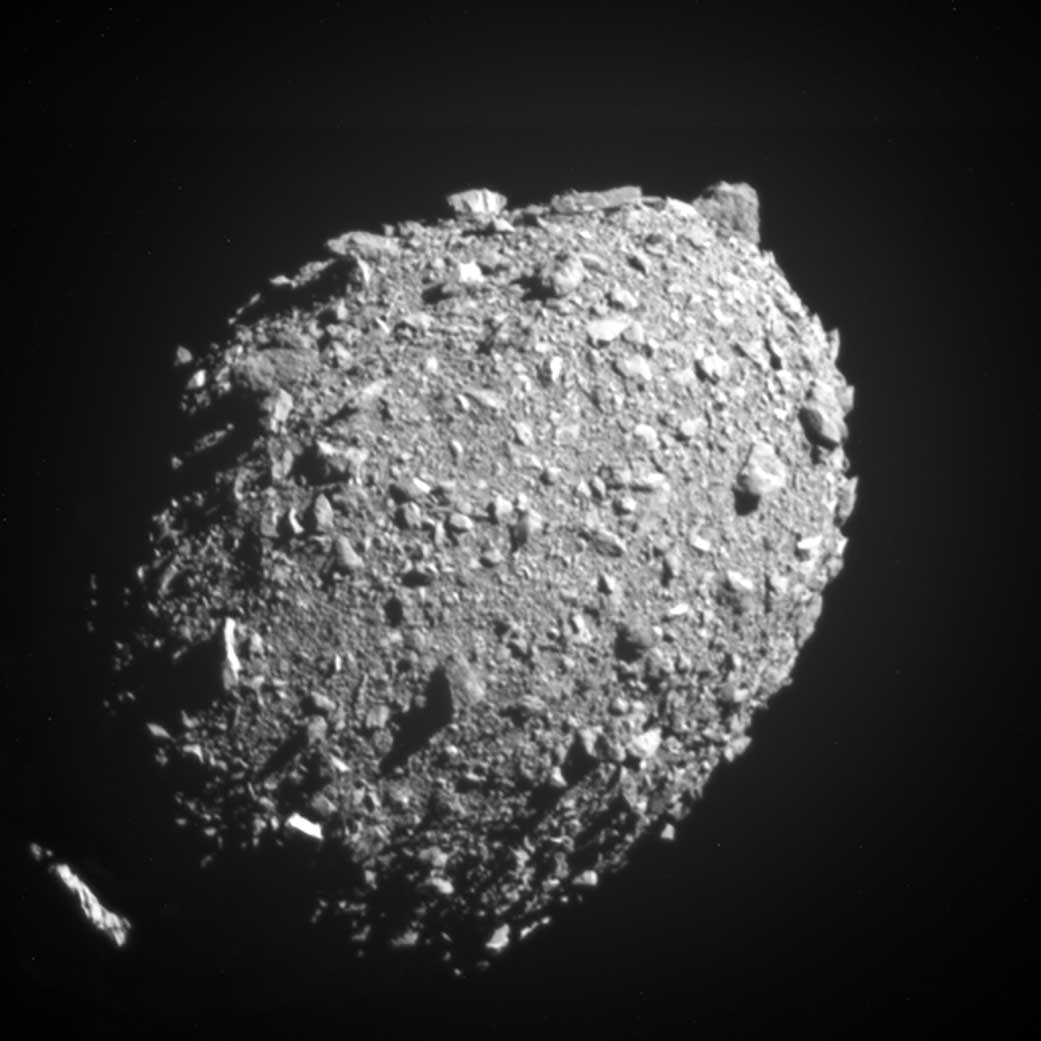
The European Space Agency’s Hera spacecraft has captured its first close-up view of the Didymos asteroid system, offering scientists a new look at the space rocks involved in humanity’s first successful test of asteroid deflection. The image, released November 5, shows the larger asteroid Didymos in detail, while its smaller companion Dimorphos is mostly hidden in shadow.

ESA said Hera acquired the new view from about 60 kilometers away. Didymos is roughly 780 meters across, while Dimorphos measures about 151 meters. The spacecraft is now approaching the system to investigate the consequences of NASA’s Double Asteroid Redirection Test, which deliberately struck Dimorphos in September 2022.
Why scientists are studying this asteroid pair

DART was designed to answer a practical planetary-defense question: could a spacecraft collide with an asteroid and change its motion? The mission struck Dimorphos at high speed and changed the small moonlet’s orbit around Didymos. Follow-up measurements found that the orbital period shortened by about 33 minutes, far exceeding the mission’s minimum success threshold.
Hera is the next step. Rather than simply confirming that an impact can change an asteroid’s motion, the mission is designed to measure the result in detail. Scientists want to understand the structure of the asteroids, the size and shape of the impact crater, the distribution of debris and the physical properties that influenced the outcome. Those measurements can help researchers improve future predictions of how an asteroid would respond to a deflection attempt.
A closer look at the aftermath

The new image reveals a side of Didymos that was not seen in the same way by DART before impact. ESA scientists described boulders, craters and patterns of grooves or ridges. Researchers are also interested in whether material ejected from Dimorphos during the DART collision traveled across the roughly one-kilometer gap and affected the surface of Didymos.
The mission’s work is not just about taking dramatic pictures. A detailed map of the asteroid pair can help scientists estimate mass, density, surface strength and internal structure. Those factors influence how much an impactor can change an asteroid’s path. A future planetary-defense mission would need accurate information about the target long before a spacecraft reaches it.
What happens next?

Hera is expected to continue its close approach and conduct a detailed investigation of the system. ESA has said additional detailed images of both asteroids are expected later in November. The spacecraft also carries instruments and companion CubeSats intended to study the asteroids from different vantage points and, if mission conditions allow, investigate the smaller body at close range.
Neither Didymos nor Dimorphos is currently considered a threat to Earth. Their value is scientific: they provide a nearby natural laboratory for testing and refining techniques that could one day be used if a hazardous object were found on a collision course with our planet.
The bottom line

Hera’s first close-up view marks an important milestone because it moves planetary defense from a successful demonstration toward a detailed scientific investigation. DART showed that a spacecraft can alter an asteroid’s motion; Hera is designed to explain exactly how the impact changed the target. The results will not provide a universal recipe for every asteroid, but they can make future deflection plans more informed, measurable and credible.
Sources and further reading

- European Space Agency — Hera’s first close-up view of Didymos
- NASA — Didymos and Dimorphos overview
- Space.com — Hera probe’s first close-up look at Didymos



Leave a Reply