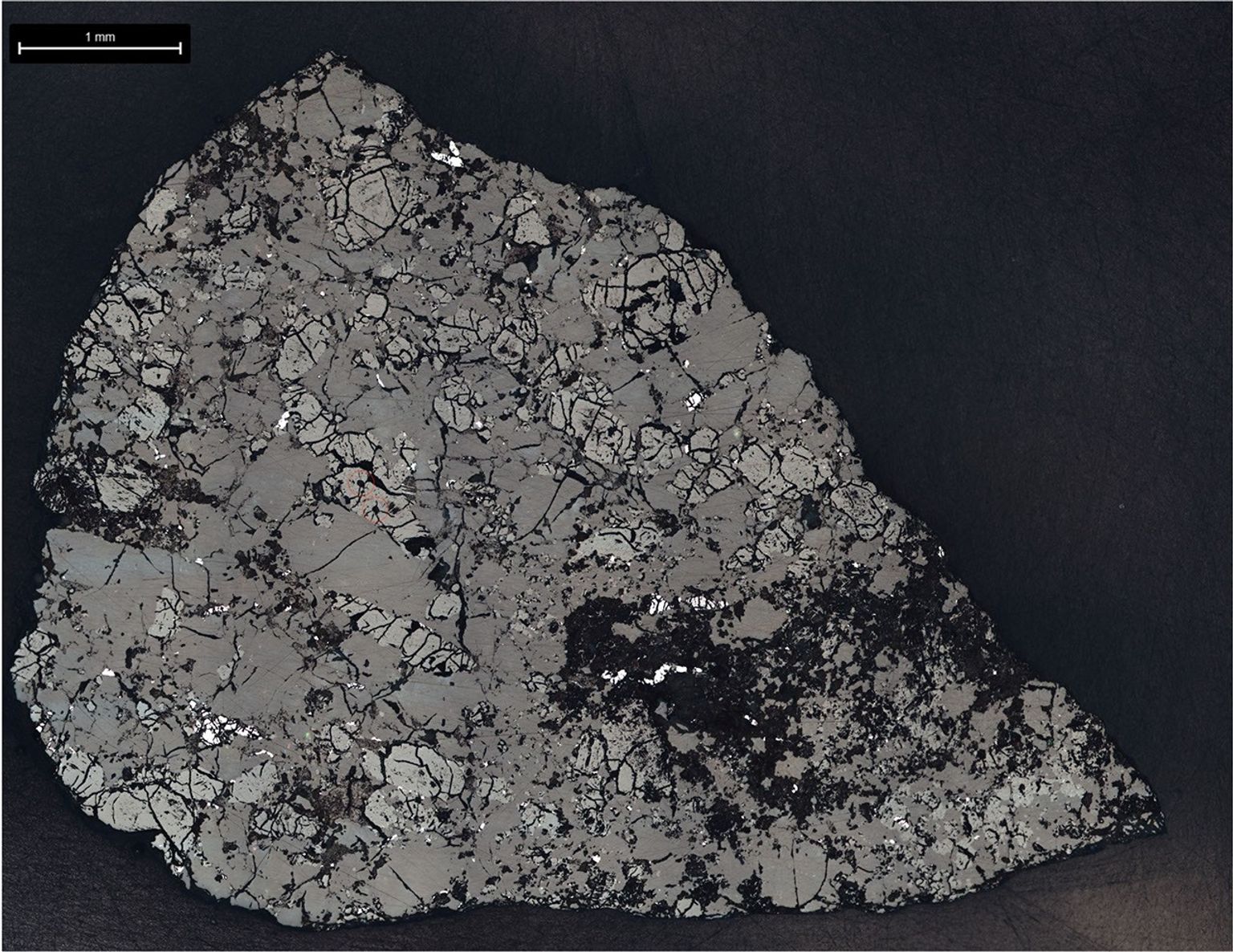
A meteorite recovered from the Sahara Desert has given scientists an unusually direct look at Mars more than 4.1 billion years ago. The rock, named Teghaza 001, formed during the planet’s earliest history and preserves evidence that water later altered its minerals. Researchers say it may represent a part of the Martian crust that has not previously been sampled by meteorites.
The discovery was reported in Science on October 29, 2026. It is significant not because it proves life existed on Mars, but because it gives researchers a rare physical sample of ancient crust and clues about how water interacted with the planet’s interior and surface.
The discovery is Teghaza 001—not Black Beauty

Teghaza 001 was found in Mali’s Sahara Desert in 2022. The recovered stones weigh nearly 800 grams combined. Scientists confirmed that the material came from Mars by comparing its oxygen-isotope signature with the distinctive chemistry of known Martian meteorites.
The distinction matters because early coverage and previous research on Mars meteorites often refer to Black Beauty, a different specimen known as Northwest Africa 7034. Black Beauty has provided important evidence about ancient Martian water, but the 2026 discovery concerns Teghaza 001. The two rocks should not be treated as the same meteorite.
How scientists established the meteorite’s age

Researchers examined tiny zircon crystals inside Teghaza 001. Zircon can preserve a record of when a rock formed, and its uranium-to-lead ratios act as a geological clock. The team’s measurements place the meteorite’s formation at more than 4.1 billion years ago, making it one of the oldest Martian meteorites identified on Earth.
The research also used an in-situ rubidium-strontium dating technique to analyze individual mineral grains while preserving most of the rare sample. That matters in planetary science: meteorites are limited pieces of other worlds, and methods that avoid dissolving large portions of a specimen leave more material available for future study.
What the rock reveals about water on ancient Mars

Teghaza 001 is an igneous rock, meaning it formed as molten material cooled. Its mineral textures and chemical composition indicate that water later interacted with the rock on Mars. The evidence includes altered minerals and oxygen-isotope measurements that point to fluids enriched in the heavier oxygen isotope, oxygen-18.
A separate 2026 study in Science Advances examined hydrogen in phosphate minerals from the same meteorite. Its results indicate a mixture of water from the magma and a heavier-isotope component linked to Mars’ ancient hydrosphere. Together, the studies help researchers investigate how water moved between the planet’s mantle, crust and surface.
That is evidence of water-rock interaction, not a discovery of fossils or living organisms. Scientists can use these chemical records to assess whether ancient environments may have been habitable, but the meteorite does not establish that life ever developed there.
Where on Mars might the meteorite have come from?

The exact place where Teghaza 001 was blasted off Mars is not known. By comparing the meteorite’s mineralogy and chemistry with observations from orbit, researchers identified 13 possible source regions. Those candidates are associated with the planet’s southern highlands, an ancient and heavily cratered area.
The map narrows the possibilities; it does not pinpoint a landing site or prove which crater launched the rock. More comparisons with orbital data and other Martian samples may help researchers refine the candidates.
Why one meteorite can change the scientific picture

Most Martian meteorites available on Earth formed much later than Teghaza 001. A sample from the planet’s early crust gives scientists a rare way to test ideas about how Mars cooled, differentiated into layers and interacted with water. It also offers a useful comparison with rocks studied by orbiters, landers and rovers.
Still, one meteorite cannot represent the whole planet. Its value is that it adds a new type of evidence to a small collection of Martian material. Future analysis may reveal more about the region it came from and the conditions that existed when the planet was young.
The bottom line

Teghaza 001 is a rare sample of Mars’ ancient crust, formed at least 4.1 billion years ago and later altered by water. Its mineral record gives researchers a stronger basis for studying the planet’s early geology and water history. It does not prove that Mars hosted life, but it helps explain why scientists continue to search for the places and periods when habitable conditions may have existed.
Sources and further reading

- NASA Jet Propulsion Laboratory: NASA-funded study details one of the oldest Mars meteorites ever found (October 29, 2026)
- Science: A Martian meteorite that formed at least 4.1 billion years ago samples Mars’ early crust and mantle
- Science Advances: A Noachian hydrosphere component in the 4.1-Ga Martian meteorite Teghaza 001
- University of New Mexico: Research team describes Teghaza 001 and its significance
- NASA Science: Map showing potential origins of Teghaza 001



Leave a Reply