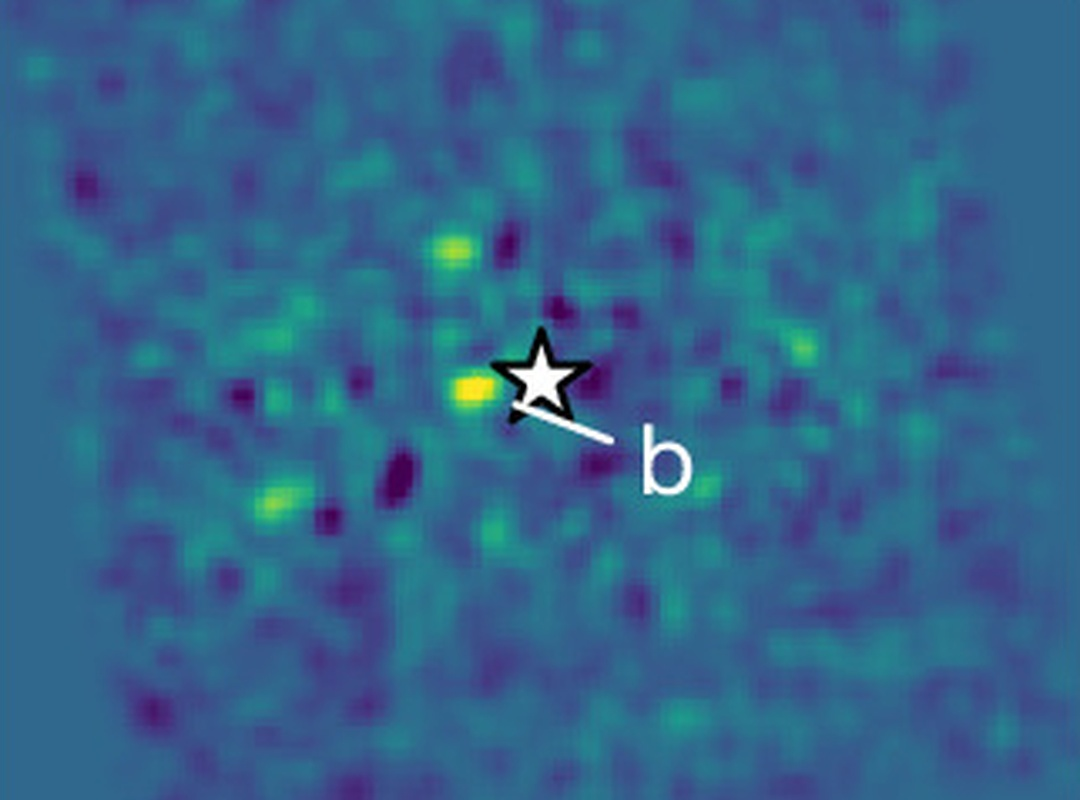
A new image-processing method has helped researchers recover the signal of a known exoplanet, 51 Eridani b, in James Webb Space Telescope observations at a wavelength of 4.3 microns. The method, called Physics-based Learning for Imaging Planets (FLIP), models the telescope’s optical system to improve the removal of starlight that can overwhelm a faint planet.
The result is not the discovery of a new planet. 51 Eridani b was already known and had been directly imaged before. The advance is that the research team recovered it in JWST data at a wavelength where standard processing methods had previously produced no detection. The paper reports sensitivity improvements of roughly two to 15 times across the datasets and comparisons tested.
What the Researchers Actually Found

The study reports the first detection of 51 Eridani b at 4.3 microns using the team’s FLIP approach. The researchers analyzed observations from JWST’s NIRCam instrument and recovered the planet’s signal at a signal-to-noise ratio of 6.3. In the same data, the standard processing approach used for comparison did not produce a detection at that wavelength.
That distinction is important. The planet itself was not previously unknown; 51 Eridani b had been discovered through direct imaging in 2015. The new result adds an observation at a different infrared wavelength and demonstrates that a more physically informed way of processing telescope data can reveal signals that conventional approaches may miss.
Infrared observations help astronomers study the light emitted by young giant planets and learn about their atmospheres. But a planet can be dramatically fainter than its host star. Even when a telescope uses a coronagraph to suppress the star’s light, residual starlight and small optical changes can obscure the planetary signal.
How the FLIP Method Works

FLIP stands for Physics-based Learning for Imaging Planets. Rather than relying only on a collection of reference images to estimate and subtract the star’s light, the method incorporates a physical model of the telescope and its optical behavior. The researchers use that model to reproduce the instrument’s point-spread function, or PSF, and then fit small changes in the optical system to better explain the science observation.
The approach matters because the shape of the starlight pattern is affected by factors such as telescope aberrations and the alignment between the star and the coronagraph. Those effects can change between observations. If reference images do not match the science image closely enough, subtraction can leave behind residual patterns or remove part of a real planetary signal.
FLIP uses a flexible physical model informed by wavefront-sensing data and a multistep optimization process. In simplified terms, it tries to explain the observed starlight using the physics of the instrument, then subtracts that model to make a faint companion easier to identify. The paper describes this as a differentiable, model-based point-spread-function subtraction framework.
Why the Planet Was Previously Undetected at That Wavelength

Direct imaging is difficult because a star can be tens of thousands or even hundreds of thousands of times brighter than the planet orbiting it in the near-infrared. A coronagraph blocks much of the star’s light, but it cannot eliminate every trace. Residual patterns from the telescope optics can be brighter than the planet signal astronomers are trying to measure.
Conventional subtraction techniques often build a model of the star’s light from reference observations. If the telescope’s optical state changes between the reference and science images, those patterns may no longer match. The subtraction then becomes less effective, leaving residual starlight that can hide a planet or create misleading features.
In the 51 Eridani b case, the research team reports that standard processing did not detect the planet at 4.3 microns in the same data, while FLIP recovered it. That makes the result a demonstration of the method’s ability to work with real on-sky observations, rather than only idealized simulations.
Broader Implications for Exoplanet Imaging

The paper reports sensitivity improvements between two and 15 times relative to standard techniques across the tested datasets. The range is not a blanket guarantee that every JWST image will become 15 times more sensitive. It describes results across the observations and comparisons examined in the study.
Better starlight subtraction could help astronomers detect fainter planets, study known worlds at additional wavelengths and make more effective use of observing time. The authors also discuss how physics-based approaches could be relevant to future observatories, including the Nancy Grace Roman Space Telescope and the proposed Habitable Worlds Observatory.
The broader lesson is that telescope performance is not determined only by the mirror and detector. The algorithms used to interpret the data also shape what scientists can reliably see. When a planet’s light is buried close to a much brighter star, improvements in modeling the instrument can open access to signals that were already present in the observations but difficult to separate.
For now, FLIP is a research method demonstrated on real JWST coronagraphic data. Its performance across more targets, instruments and observing conditions will determine how broadly it can be adopted. The 51 Eridani b result is an encouraging proof of concept, not a claim that every hidden exoplanet can now be recovered.
For another recent look at how space research can reshape our understanding of planetary origins, see our report on what Bennu’s asteroid samples reveal about amino-acid origins.
Why the 4.3-Micron Wavelength Matters
The new observation is especially interesting because 4.3 microns falls in a carbon-dioxide absorption band. The Nature paper reports a signal-to-noise ratio of 6.3 for 51 Eridani b in JWST’s F430M data. The authors describe it as the first image of the planet at this wavelength. Because Earth’s atmosphere absorbs strongly in this part of the infrared spectrum, the wavelength is not accessible to the same kind of ground-based measurement, making space-based observations particularly valuable.
Carbon dioxide can help astronomers investigate a planet’s atmospheric composition and metallicity. The researchers say future work can use the new detection to measure the planet’s 4.3-micron photometry and improve its atmospheric characterization. That is a next step, not a result already completed by the current image: the detection creates an opportunity for more detailed analysis rather than delivering a full atmospheric inventory on its own.
How 51 Eridani b Became a Known Planet
51 Eridani b was first reported in 2015 using the Gemini Planet Imager. The discovery study described it as a young giant planet orbiting a star about 20 million years old, at a projected separation of roughly 13 astronomical units. Its early near-infrared spectrum showed strong methane and water-vapor absorption, and the researchers’ models suggested a mass around twice that of Jupiter. Those estimates came from the earlier study; the new JWST result is about recovering a signal at a different wavelength, not revising the planet’s discovery date.
The background matters because the planet was never a newly discovered object in this research. The advance is a new view of a known world and a demonstration that the way scientists model a telescope can affect which faint signals they can recover. The 2015 discovery paper is available through PubMed, while the 2026 FLIP study provides the new JWST analysis.
What the Study Does—and Does Not—Prove
The team tested FLIP on JWST observations of more than one target, including systems with known planets and a dataset where artificial planet signals were inserted to test sensitivity. Across the datasets examined, the paper reports improvements of up to 15 times compared with published analyses using standard pipelines. The gain depends on the target and observing conditions; it is not a universal multiplier for every JWST image.
The result also does not mean that FLIP can reveal every planet hidden in starlight. Its performance still depends on the quality of the telescope data, the accuracy of the optical model and the ability to distinguish a real planetary signal from residual noise. The strongest conclusion is narrower and more useful: physics-based modeling helped recover a real planet in JWST data at a wavelength where the standard comparison method did not detect it.
For another example of how new analysis can extract information from space observations, see our report on Hubble’s observations of oxygen in 37 dwarf galaxies.
What to Know
Researchers used FLIP to recover the known exoplanet 51 Eridani b in JWST NIRCam observations at 4.3 microns, with a reported signal-to-noise ratio of 6.3. Standard processing did not detect the planet in the same data. The study reports two-to-15-times sensitivity improvements across tested datasets and points to possible applications for future space telescopes.
Sources
- Nature: Imaging exoplanets below the telescope stability limit
- Northwestern University: Hidden planet emerges from the glare
- EurekAlert: Research release on the FLIP method





Leave a Reply
You must be logged in to post a comment.