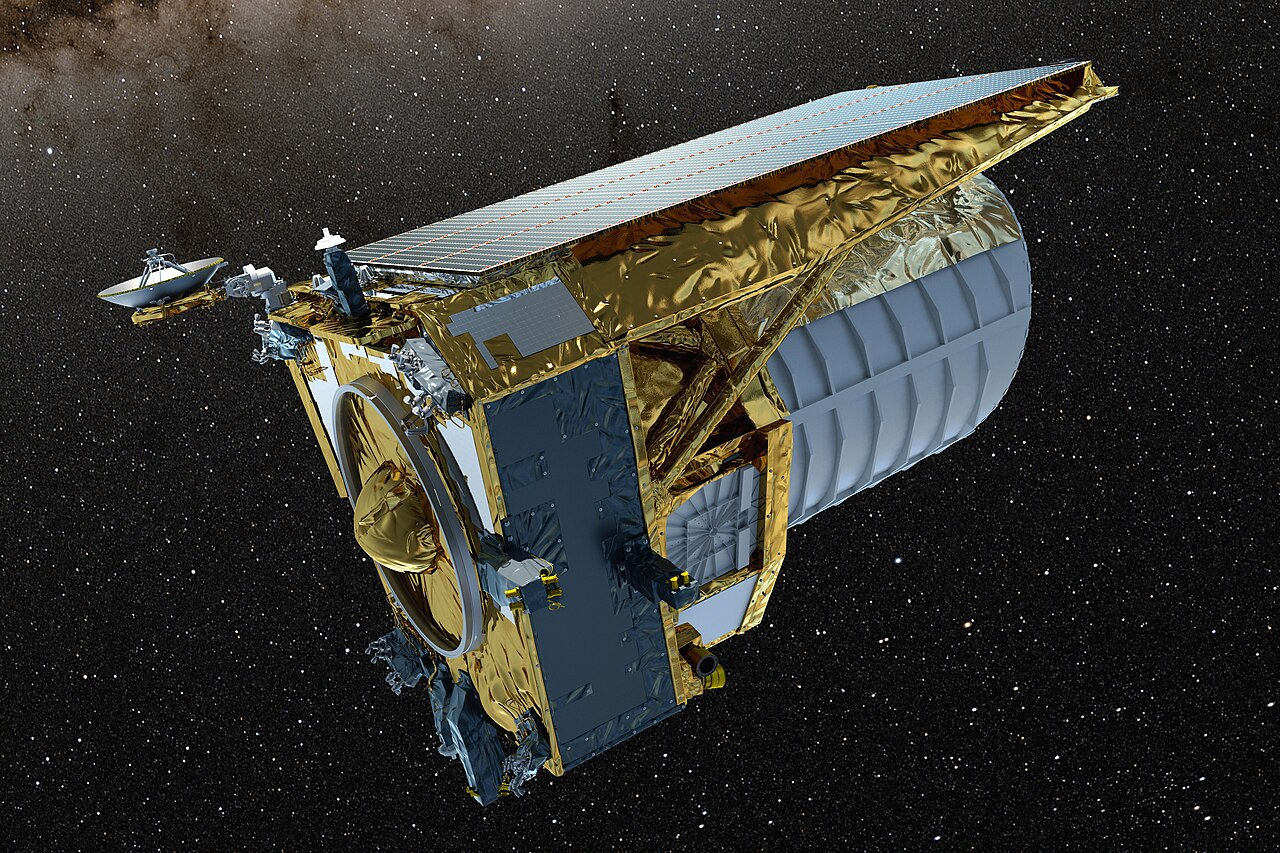
The most distant quasar ever found is shining at us from just 630 million years after the Big Bang — a supermassive black hole already weighing about 360 million times the mass of the Sun, seen as it was 13.1 billion years ago. The discovery, announced November 24, 2026 by the European Space Agency, breaks a record set only four months ago by the very same telescope.
What Is J1504+6252 — and Why Is It Called Dún Aonghasa?
Formally the object is J1504+6252. The team nicknamed it Dún Aonghasa, after a prehistoric stone fort perched on a cliff on Inis Mór, off the west coast of Ireland — a fort that faces the vast ocean, just as the quasar stands at the edge of what telescopes can see. It is the first quasar ever found beyond a redshift of 8 — redshift 8.13, to be exact. Redshift is how astronomers measure distance and age: the higher the number, the further back in time. At redshift 8.13, the light now reaching us left the quasar when the universe was only about 5% of its current age. A quasar is the blazing core of a young galaxy, where a supermassive black hole swallows gas and dust so violently that the infalling material glows brighter than the entire galaxy around it.
How Euclid Found It

The quasar turned up in about 18 months of data from ESA’s Euclid space telescope, which launched in July 2023 to map a third of the sky. The team, led by Julien Wolf of the Max Planck Institute for Astronomy, sifted through millions of objects in the Euclid Wide Survey to find the candidate. Then came the confirmation: follow-up observations with the Hubble Space Telescope, the James Webb Space Telescope, the Large Binocular Telescope in Arizona, and the W. M. Keck Observatory in Hawaii. The follow-up images showed luminous blue light — the signature of a disk of gas spiraling into a black hole — and spectra with broad emission lines from gas clouds whipping around the black hole in tight orbits. Those lines pinned down the distance: 630 million years after the Big Bang.
A 360-Million-Sun Black Hole, 40 Million Years Earlier Than the Last Record

The previous record-holder was found by the same Euclid team in July 2026 — one of 31 early quasars they published from the survey’s first data. J1504+6252 is about 40 million years older still. From the gas orbiting the black hole, the team measured its mass: between 200 million and 800 million times the mass of the Sun, with the Webb data pointing to about 360 million Suns. Here is the puzzle: the universe was only 630 million years old. A black hole that big, that early, should not have had time to grow by slowly eating gas. And the observations show it is currently feeding well below its theoretical speed limit, so it was not always a fast eater either. Something in the early universe made giant black holes fast — and astronomers still do not fully agree on what.
What It Means for How Black Holes Were Born

The discovery favors one explanation: direct collapse. In that scenario, a massive cloud of gas in the early universe collapses under its own gravity and forms a large black hole directly, skipping the slow step of a star forming, dying, and leaving a small black hole behind. The team’s calculations show the direct-collapse model fits what they see in J1504+6252. But the researchers are careful about the limit of that idea: if even older, even bigger black holes turn up, direct collapse alone may not be enough to explain them. Euclid is still surveying, and the team expects to find more — each one narrowing down how the first stars, galaxies, and supermassive black holes came to be.
Bottom line: J1504+6252, nicknamed Dún Aonghasa, is the oldest and most distant quasar ever found — a 360-million-sun black hole shining 630 million years after the Big Bang, 40 million years further back than the previous record. Its existence is strong evidence that the first giant black holes were born big, through direct collapse, rather than growing slowly from stellar seeds.
Sources: European Space Agency (Euclid breaks own quasar record, Nov 24, 2026) · Max Planck Institute for Astronomy · Sky & Telescope · Popular Science · Wolf et al., Astronomy & Astrophysics, 2026, DOI: 10.1051/0004-6361/202662243.
Reporting status checked November 24, 2026.
Don’t stop here. Explore more stories from The Immortal Times.


Leave a Reply
You must be logged in to post a comment.