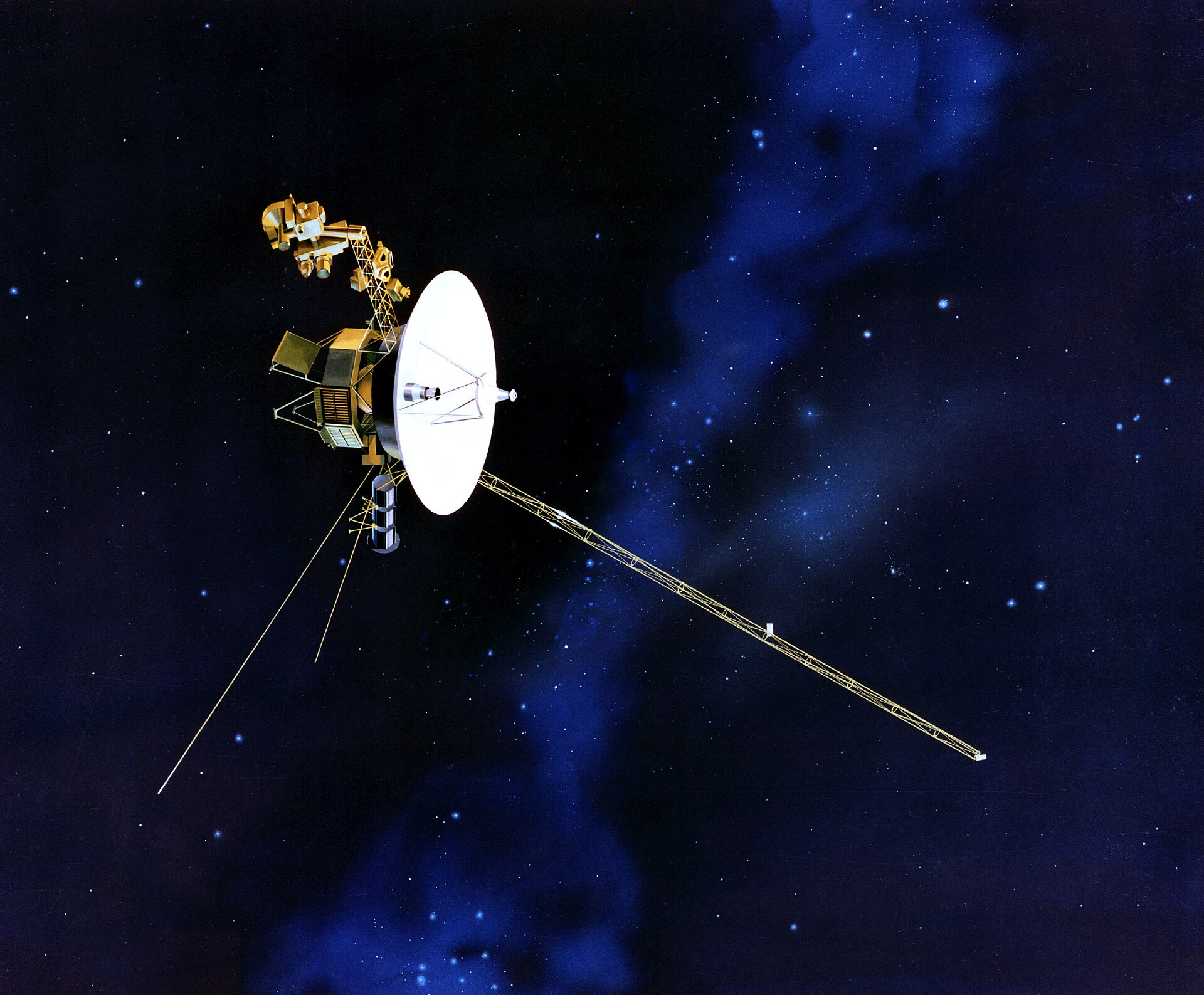
On Wednesday, November 18, 2026, at 5:16 a.m. Eastern, NASA’s Voyager 1 became the first human-made object to reach one light-day from Earth — about 16.1 billion miles (25.9 billion kilometers) away, a distance so large that its radio signals, moving at the speed of light, now take a full 24 hours to reach us. The Voyager team at NASA’s Jet Propulsion Laboratory in Southern California heard back from the probe 24 hours later, early Thursday, exactly as the math said they would. Voyager 1 has held the “farthest spacecraft” title since 1998. This milestone gives that record a new unit: humanity’s most distant object is now measured in days of light-travel time.
What Does One Light-Day From Earth Actually Mean?

A light-day is a distance, not a duration: it is how far light travels in 24 hours. Light moves at about 186,000 miles (299,000 kilometers) per second in a vacuum, which adds up to roughly 16.1 billion miles in a day. NASA puts the comparisons in terms that almost make it graspable. Sunlight passing Earth takes about 1.3 seconds to reach the Moon, about four hours to reach Neptune — and another 20 hours to reach Voyager 1. A light-year, for scale, is 5.88 trillion miles, which is why Voyager 1, for all its speed, would need on the order of 18,000 more years to reach one light-year from home.
The practical consequence is a 48-hour conversation loop. “We listen to Voyager 1 every day and send commands to the spacecraft weekly. It just takes a little longer to communicate than it used to,” said Suzanne Dodd, Voyager project manager at JPL, in NASA’s release. “Even traveling at the speed of light, signals now take 24 hours to reach the spacecraft and 24 hours to reach us.” Every command is a letter, not a phone call: engineers send instructions through the Deep Space Network’s giant antennas in California, Spain and Australia, then wait two days to learn what happened. Flight controllers confirmed the milestone the same way, receiving the spacecraft’s call on Thursday, 24 hours after it was sent, via the deep-space station near Madrid, the Associated Press reported.
How Voyager 1 Got to 16.1 Billion Miles

Voyager 1 has been traveling for more than 49 years. Its twin, Voyager 2, actually launched first, on August 20, 1977; Voyager 1 followed on September 5, 1977, on a faster trajectory that soon put it ahead for good. The pair were built to exploit a rare alignment of the outer planets — the “Grand Tour” — and they were only the third and fourth spacecraft to visit Jupiter and Saturn, returning the first high-resolution imagery of those worlds and transforming what scientists knew about them and their moons. Voyager 2 went on alone to Uranus and Neptune; Voyager 1 turned north out of the planetary plane and kept going, at what NASA clocks today at nearly 38,000 mph (61,155 kph).
The records stacked up along the way. In 1998, Voyager 1 passed Pioneer 10 to become the most distant human-made object, a title it has never given back. In 2012, it became the first spacecraft to leave the heliosphere — the bubble of particles and magnetic fields blown out by the Sun — and enter interstellar space. It is now heading in the direction of the star Gliese 445, more than 17 light-years away, which it will pass at a distance of about 1.6 light-years in roughly 40,000 years. Nothing about the spacecraft changed on November 18; as JPL has noted, the milestone is a marker on a trajectory, not an event on board. As Caltech’s Alan Cummings, who has worked on Voyager’s Cosmic Ray Subsystem since before launch, told Spaceflight Now, it is “not a scientific milestone — it is an engineering milestone, though.” That distinction matters, and it is also slightly beside the point: engineering is the only reason there is still a mission to have milestones.
It is worth pausing on how improbable the hardware story is. The probes flying today run on 1977 technology, kept alive by creative engineering — clogged thrusters worked around, a malfunctioning computer routed past, and, earlier this year, three devices on Voyager 1 switched off and replaced with lower-power alternatives to stretch its nuclear battery. Modern missions are still finding new science in old data, too — the same trick astronomers just used when a new technique pulled a hidden planet out of two-year-old telescope images, as we covered in JWST’s FLIP Method Reveals 51 Eridani b.
The Only Probes in Interstellar Space

Voyager 1 and Voyager 2 remain humanity’s only probes in interstellar space, and they are still doing science there — measuring how the Sun’s magnetic field and particles behave at distances no other instrument can reach. “The Voyagers are revolutionizing our understanding of interstellar space, a previously unexplored region outside the heliosphere,” said Linda Spilker, Voyager project scientist at JPL. “One big surprise is the extent to which our Sun continues to affect interstellar space, all the way out to Voyager 1. Where does the Sun’s influence end and pristine interstellar space begin? Perhaps Voyager may endure long enough to answer that question.”
There is one honest complication in this week’s celebration, and NASA stated it plainly in its own release: the team has not received science and engineering data from Voyager 1 since November 14. What the spacecraft is sending is its carrier signal — the tone that normally carries the data — and engineers used that signal plus trajectory calculations to confirm the light-day milestone while they continue analyzing the data problem. So the confirmation is solid, and the underlying issue is real and unresolved. Both things belong in the story. Europe’s Hera mission is doing a similar kind of long-tail science closer to home, as our report on ESA’s Hera and its first close look at Didymos explains.
Voyager 2, meanwhile, is more than 13.4 billion miles away on its own trajectory, with signals taking about 20 hours to reach it. It is on pace to reach one light-day from Earth in November 2035 — though whether either probe will still be transmitting by then is an open question.
How Much Longer Can Voyager 1 Keep Calling Home?

Power is the countdown clock. Each Voyager runs on a radioisotope thermoelectric generator — a nuclear battery converting heat from decaying plutonium into electricity — and each loses about 4 watts of power a year as the plutonium decays. NASA’s latest energy-saving effort, switching off three devices on Voyager 1 and substituting lower-power alternatives, is expected to keep both spacecraft’s current science instruments running until at least their 50th launch anniversaries next summer, in 2027. The probe is already down to a small suite of working instruments, and every future year is negotiated watt by watt.
When the signals finally stop, the spacecraft will not. Both Voyagers carry the Golden Record, a gold-plated copper phonograph of images and sounds from Earth, meant for any advanced civilization that might one day find it. “One day in the future, when it can no longer communicate with Earth, Voyager 1 will become humanity’s silent ambassador to the stars,” Dodd said. “It’s never happened before, and it may never happen again — it’s that kind of extraordinary,” added Kareem Badaruddin, Voyager mission manager at JPL, in CNN’s coverage. The next round-number milestone is a long way off — but at 38,000 mph, Voyager 1 adds another light-hour roughly every 25 days, and it is not slowing down. For more journeys measured in decades, see our coverage of the Hubble discovery of missing oxygen in 37 dwarf galaxies.
Bottom line: Voyager 1 reached one light-day from Earth — about 16.1 billion miles — at 5:16 a.m. Eastern on November 18, 2026, becoming the first human-made object that far away and turning every exchange with NASA into a 48-hour round trip. The milestone is symbolic, but the mission behind it is not: after 49 years, the probe is still the only instrument humanity has in interstellar space on its trajectory, still reporting on the Sun’s reach — once engineers resolve the data interruption that began November 14 — and still powered, watt by shrinking watt, toward its 50th anniversary next summer.
Sources:
- NASA’s Voyager 1 Makes History Reaching One Light-Day From Earth — NASA
- Voyager 1, the farthest human-made object, is now one light-day from Earth — CNN
- NASA’s Voyager 1 is now a light-day away from Earth. What that means — USA Today
- NASA’s Voyager 1 Has Reached One Light-Day From Earth — Smithsonian Magazine
- NASA’s Voyager 1 is one light-day from Earth — Spaceflight Now
- NASA’s Voyager 1 phones home from an awe-inspiring one light-day away — Associated Press
Reporting status checked November 22, 2026. NASA had confirmed the light-day milestone via Voyager 1’s carrier signal; science and engineering data from the spacecraft had been interrupted since November 14, 2026, and engineers were still analyzing that issue at check time. This article will be updated as NASA reports on the data problem and the mission’s 50th-anniversary plans.
Don’t stop here. Explore more stories from The Immortal Times.



Leave a Reply
You must be logged in to post a comment.