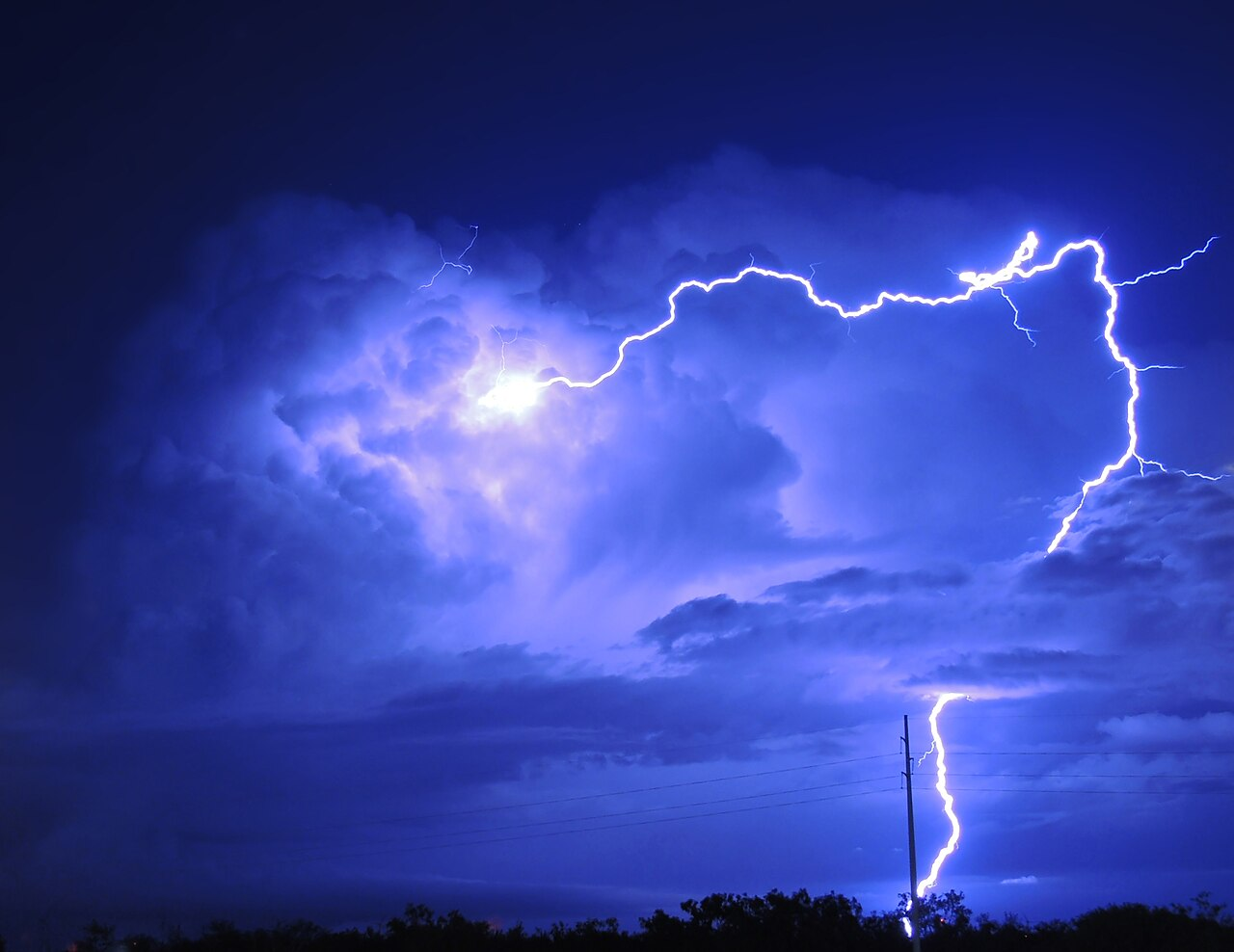
Lightning could strike more than twice as often by the end of the century. A new study published Tuesday in Earth’s Future, the journal of the American Geophysical Union, finds that cloud-to-ground lightning — the bolts that actually hit the Earth — could become 76% to 140% more common by 2100 than in 1995–2014, if greenhouse gas emissions stay high. That is far above what earlier research predicted, and the study’s lead author says he was surprised by how large the numbers came out.
The Study in Numbers
The research was led by Andreas Krause, an Earth system scientist at the Technical University of Munich, with colleagues from Vrije Universiteit Amsterdam and the University of East Anglia. The team trained a machine-learning model on lightning and climate observations from 2019 — temperature, rainfall, humidity, air pressure, wind speed, and incoming solar radiation — then ran it backward and forward through different climate conditions.
- 1901–1920 to 1995–2014: cloud-to-ground lightning rose about 11% — roughly 12% for every degree Celsius of warming.
- Older estimates for the future: about 8% to 17% more lightning per degree of warming.
- This study, high-emissions future (SSP3-7.0): about 30% more lightning per degree of warming — nearly three times as sensitive.
- By 2100 vs. 1995–2014: 76% to 140% more ground strikes, depending on the climate model.
- Alaska could see up to 594% more ground strikes, according to coverage of the study — one of the largest regional jumps anywhere.
The paper is “Large Projected Increase in Cloud-to-Ground Lightning Under Future Climate,” published in Earth’s Future, DOI: 10.1029/2026EF008820.
Why Lightning Increases as the Planet Warms

As the climate warms, heat rising from the Earth’s surface shakes up the atmosphere more violently. Warm air rises, stirs ice crystals inside storm clouds, and the collisions build up electric charge until it discharges as a bolt. Stronger convection means more charge, more often. The study’s model found that this relationship gets much more sensitive as the planet gets hotter — which is why the new projections are so much higher than the old ones. “There is actually quite a large uncertainty about how lightning will respond to climate change,” Krause said, and even he did not expect the increase to be this large: “I was quite surprised that the projections were so high.”
Where Strikes Will Rise Most

The total number of strikes is projected to rise most in the tropics, where lightning is already most common — especially in the Amazon, Southeast Asia, and Oceania. The researchers stressed that the Amazon projections carry the most uncertainty, because future climate conditions there may look very different from the historical conditions the model was trained on. The rise will not be even: some regions, like Alaska, see enormous percentage jumps from a low starting point, while the tropics see the largest growth in the sheer number of strikes.
Why It Matters: Wildfires, the Grid, and Infrastructure

Cloud-to-ground lightning is the dangerous kind. These are the bolts that spark wildfires, damage wind turbines and power lines, and threaten offshore oil rigs and other infrastructure. More strikes means more fire starts in forests that are already drier and hotter, more stress on power grids during storm season, and more risk to the energy infrastructure being built to fight climate change itself — wind turbines are tall, exposed, and exactly what lightning hits. The study does not predict a specific number of fires or outages, but it changes the planning math: infrastructure designed for the lightning of the last century will face up to twice as much of it by the end of this one.
Bottom line: In a high-emissions future, ground-striking lightning could rise 76% to 140% by 2100 — about 30% more per degree of warming, nearly triple the sensitivity older studies assumed. The tropics see the biggest rise in total strikes, Alaska the biggest percentage jump, and the grid, forests, and wind turbines are all in the firing line.
Sources: American Geophysical Union / Earth’s Future (Krause et al., 2026, DOI: 10.1029/2026EF008820) · Phys.org · Scientific American.
Reporting status checked November 24, 2026.
Don’t stop here. Explore more stories from The Immortal Times.


Leave a Reply
You must be logged in to post a comment.